Press Road Coverage: A More Balanced View is Needed
Partial Concepts are not Facts
Recent CDA Press coverage of North Idaho road projects, including the “Road projects upset some motorists; officials explain why they’re needed,” has largely presented the perspective of the Kootenai Metropolitan Planning Organization (KMPO), the Idaho Transportation Department (ITD), and other public agencies. While those viewpoints deserve consideration, readers are also entitled to understand the broader funding realities, alternative solutions, and long-term costs that receive little attention in public discussion.
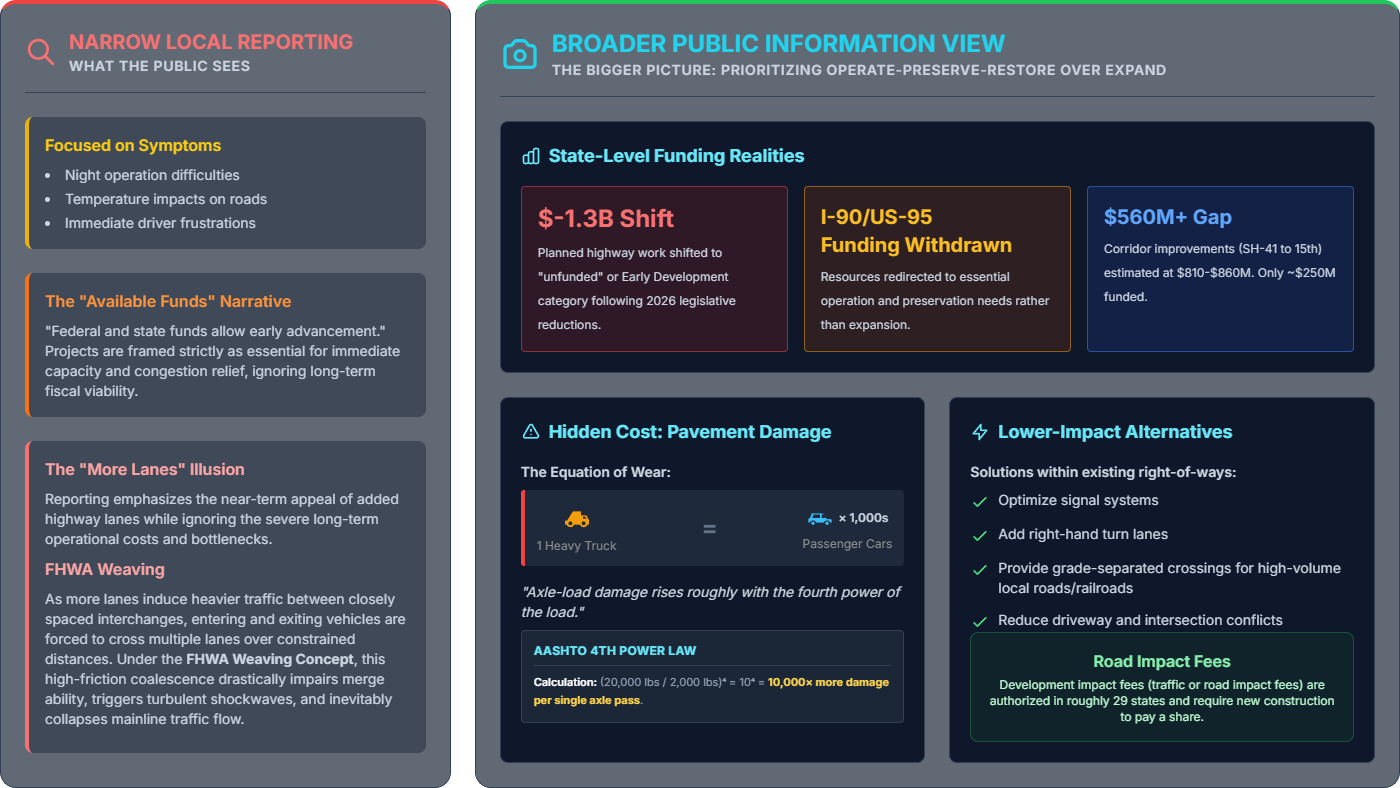
Key issues not covered well include state-level funding realities that reduced expected spending by $1.3 billion, lower-impact alternatives that offer better and safer transportation, and pavement damage caused by heavy trucks from local development.
The transportation department ... unveiled its draft seven-year plan, which placed nearly $1.3 billion worth of planned highway work into an "unfunded" category, effectively freezing the projects until funds are restored or new funds are found.
More than $1B in Idaho highway projects meant for growth put on 'unfunded' listIdaho Statesman (source)
The CDA Press article quotes ITD officials who argue that available federal and state funding allowed I-90 widening and related projects to move forward sooner than expected. The work is presented as necessary to improve capacity, reduce congestion, and address safety concerns associated with growth.
What is missing is the contemporaneous state picture. Following 2026 legislative reductions in transportation appropriations, ITD shifted roughly $1.3 billion in planned highway work into an “unfunded” or Early Development category and is prioritizing “Operate, Preserve, Restore” over Expand.
The I-90/US-95 Interchange construction funding was withdrawn so resources could be directed to operation and preservation needs. Broader corridor improvements between SH-41 and 15th Street carry preliminary estimates of $810–860 million, of which only about $250 million has been funded to date. Future phases remain contingent on statewide needs and funding availability.
Without discussing these constraints, coverage can leave readers with an incomplete understanding of the state’s fiscal realities and the difficult prioritization decisions ahead.
More importantly, it can perpetuate the idea that lower-cost options cannot improve outcomes.
Is More Capacity the Only Answer?
Coverage also tends to assume that roadway widening is the best available solution.
Federal Highway Administration (FHWA) research and transportation planning literature have long recognized that adding general-purpose lanes often induces additional vehicle travel. While new lanes may provide temporary relief, they frequently attract additional trips and development patterns that eventually recreate congestion.
Empirical research demonstrates that as roadway supply increases vehicle miles traveled (VMT) generally does, too. This is the “induced travel” effect—a net increase in VMT across the roadway network due to an increase in roadway capacity, which ultimately erodes any initial increases in travel speeds and causes increased GHG emissions.
The central issue on many North Idaho corridors may not simply be roadway capacity. Merge conflicts, closely spaced intersections, driveways, railroad crossings, missing right-hand turn lanes, and signal timing often create significant operational problems. Under the FHWA definition of Weaving, this high-friction coalescence drastically impairs merge ability, triggers turbulent shockwaves, and inevitably collapses mainline traffic flow.
Many of these improvements can be implemented largely within existing rights-of-way, reducing impacts on adjacent property owners and costs. Building more roads does not mean making driving safer or faster.
Federal transportation guidance generally encourages agencies to minimize property impacts whenever feasible. Projects that require substantial land acquisition should be carefully evaluated against alternatives that may achieve similar outcomes with fewer disruptions. The current methodology for the KMPO and ITD does not follow this concept.
Construction Costs Deserve More Attention
Another missing piece of the public discussion involves the cost of building these projects.
Media coverage frequently focuses on traffic delays, lane closures, or the challenges of nighttime construction. Less attention goes to the actual cost of those methods.
Industry surveys and transportation studies commonly find that nighttime highway construction costs can range from roughly 0% to 25% more than comparable daytime work. Details on where nighttime operations could reduce friction in thousands of people’s lives would be beneficial and should not be determined without community feedback.
Scheduling construction activities during nighttime, when traffic demand is typically at its lowest levels, is being viewed by many transportation agencies as an effective strategy to alleviate the negative impacts of work zones on the traveling public.
The Hidden Cost of Heavy Construction Traffic
Construction itself can accelerate deterioration of the road system.
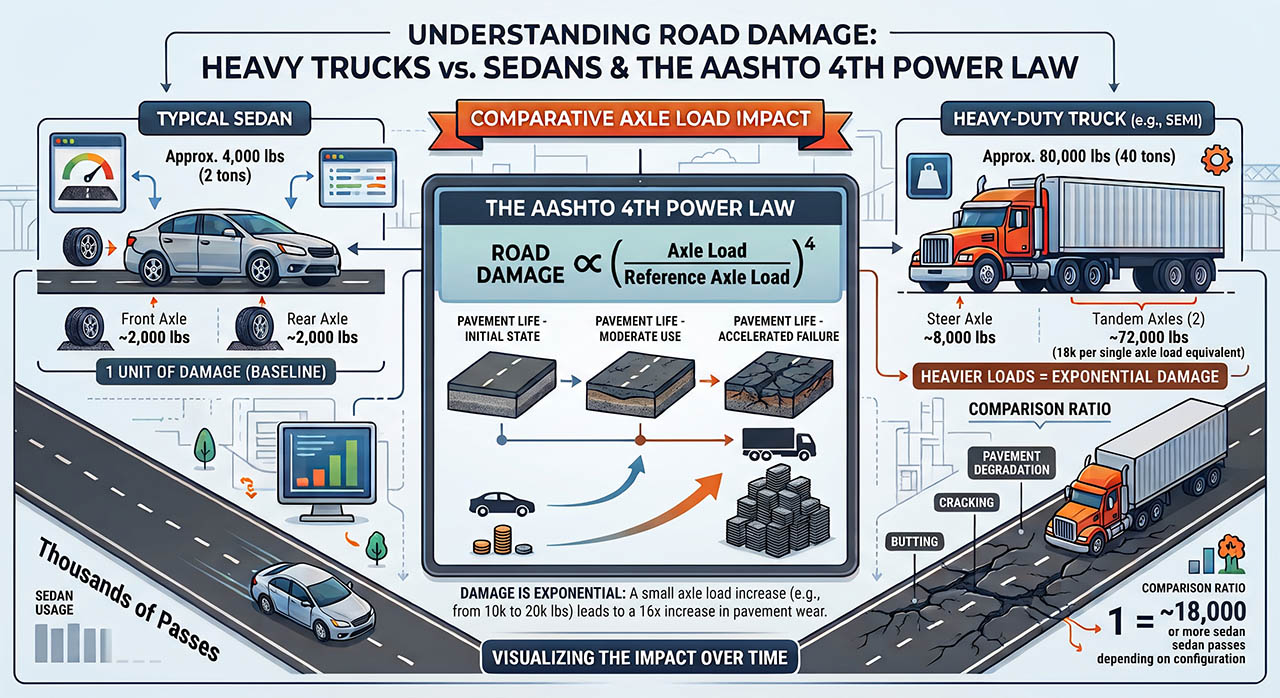
Federal and state pavement research consistently shows that pavement damage increases dramatically as axle weight rises; this is known as the AASHTO 4th Power Law. A single fully loaded truck can impose wear equivalent to thousands of passenger vehicle trips.
During large development projects, excavators, bulldozers, haul trucks, loaders, and other heavy equipment make repeated trips across local roads and access routes. These movements contribute to rutting, cracking, and reduced pavement life. However, this can also happen as traffic patterns change because road projects send transportation trucks through areas they are not expected to use.
Those costs are real, even when they are not directly visible in project budgets.
Many states address this issue through transportation impact fees, heavy-haul permit fees, weight-distance taxes, or other mechanisms designed to recover at least part of the infrastructure costs generated by construction and freight activity.
Although Idaho jurisdictions already collect transportation-related impact fees, public discussions rarely address whether existing fee structures adequately account for pavement damage caused during major construction projects.
The AASHTO Fourth Power Law (also termed the Generalized Fourth Power Law) is an empirical engineering principle originating from the AASHO Road Test conducted in Ottawa, Illinois, between 1958 and 1960. It states that the relative structural damage inflicted on a pavement surface by an axle pass is proportional to the fourth power of the axle load.
- An 80 kN (18,000 lbs) single axle does over 3,000 times more damage to a pavement than an 8.9 kN (2,000 lbs) single axle (1.000/0.0003 ˜ 3,333).
- A 133.3 kN (30,000 lbs) single axle does about 67 times more damage than a 44.4 kN (10,000 lbs) single axle (7.9/0.118 ˜ 67).
- A 133.3 kN (30,000 lb) single axle does about 11 times more damage than a 133.3 kN (30,000 lb) tandem axle (7.9/0.703 ˜ 11).
- Heavy trucks and buses are responsible for a majority of pavement damage. Considering that a typical automobile weighs between 2,000 and 7,000 lbs (curb weight), even a fully loaded large passenger van will only generate about 0.003 ESALs while a fully loaded tractor-semi trailer can generate up to about 3 ESALs (depending upon pavement type, structure and terminal serviceability)
A More Balanced View Is Needed
A balanced public discussion would include state funding shortfalls and prioritization shifts, induced-demand evidence, quantified safety and mobility performance of access management, adding right-hand turn lanes, and multimodal packages. Instead, the focus is on pure capacity expansion, right-of-way needs, and the additional pavement consumption caused by the heavy machinery required to build the projects themselves.
Taxpayers deserve full context when evaluating whether current construction schedules and long-term proposals serve safety, mobility, fiscal responsibility, and the federal preference for designs that minimize the need to condemn private property. For years, a lack of transparency and misinformation has required interested citizens to request information under the Freedom of Information Act or the Idaho Public Records Act. The request would be easier to handle if the responses didn’t cost an extreme amount to deliver.
It is time that Kootenai County voters be treated with the respect they deserve. The people in place to serve the community’s best interests should begin meeting that requirement. The days when public representatives say, “[i]t boils down to whose ox is going to get gored,” need to become a thing of the past.