

Enrich the Details · Review
How Do Annexations Impact You in Idaho?
by Brian Rogers 20 min read
On this page
The Coeur Terre lesson
In the winter and early spring of 2023, scores of Coeur d’Alene and Kootenai County neighbors learned how Idaho annexation law works by living through it.
Kootenai County Land Company asked the City of Coeur d’Alene to annex about 440 acres of farmland north of Interstate 90 and east of Huetter Road, and to zone it for a project called Coeur Terre. The zoning alone could allow for more than 5,000 homes. A development agreement caps the project at 2,800 “equivalent residential units,” a planner’s measure that counts homes and commercial space together by their demand on city services.1 The city’s planning commission recommended approval on October 11, 2022, by a vote of 6 to 0.2 The city council held a public hearing on February 7, 2023, at a meeting that ran nearly six hours, then voted to defer its decision.3 On February 21, the council voted to reopen the hearing.4,5 On March 21, 2023, after a second hearing of about four hours, it approved the annexation ordinance (Council Bill 23-1002) and the annexation and development agreement (Resolution 23-012), each by a vote of 4 to 2.6,7 The agreement carries a $2 million annexation fee, payable to the city in two installments.1
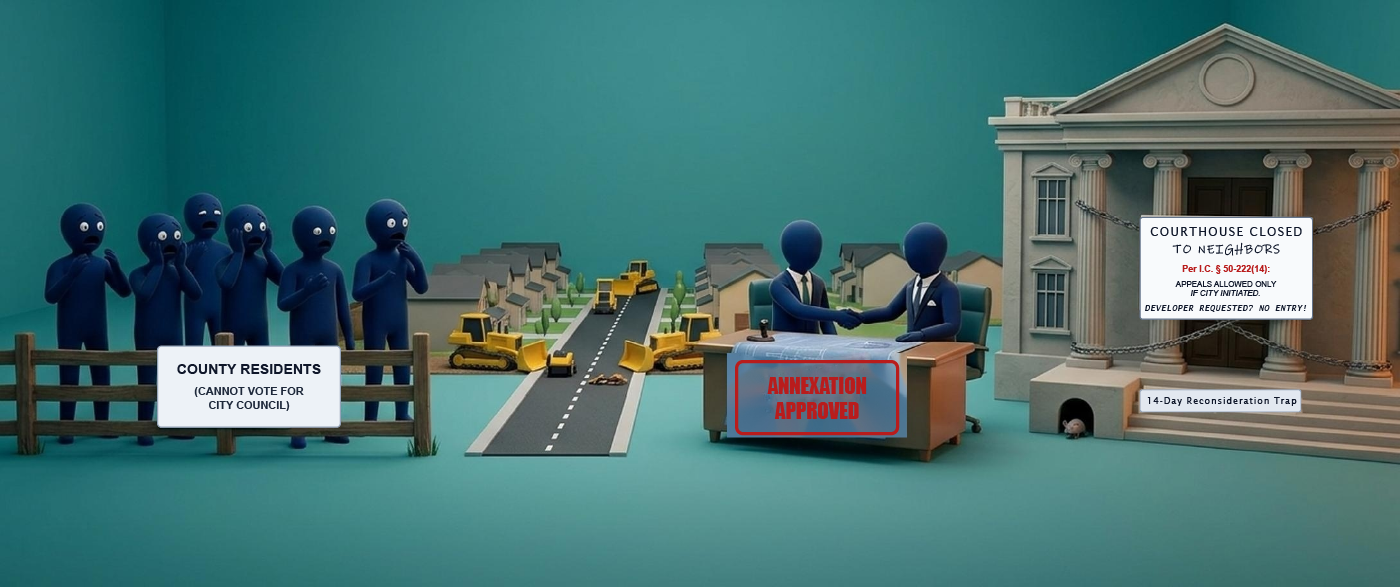
Neighbors wrote letters, signed a petition, and testified.8 The council packet holds more than 300 pages of written public comment, and about 100 people filled the library community room for the March hearing.1,7 Many of the opponents lived in the Indian Meadows subdivision inside the city.9 Others lived just outside the city limits along and west of Huetter Road, which meant they could not vote for or against the council members deciding the matter.1
When opponents disputed the law, the developer’s attorney wrote to the mayor and council on March 16, 2023, to answer what the letter called “misstatements … regarding the governing case law.” Because every landowner inside the annexation area had requested it, and because the land lay inside the city’s area of city impact (the county land around a city that the city plans to grow into) and its comprehensive-plan annexation area, the letter said, this was a “Category A” annexation, and “no appeal by a petition for judicial review of the Category A annexation is allowed.“1 In plain terms, no neighbor could appeal the council’s decision with a judge.
That was a correct statement of Idaho law in 2023. Whether it is still correct today depends on a phrase, “city-initiated annexation,” that the Legislature wrote in 2024 and never defined furthering confusion on the topic.
How annexation works in Idaho
Cities appear to annex land under one statute, Idaho Code section 50-222, with hearings governed by the Local Land Use Planning Act (section 67-6525).10,11 The Legislature repealed and replaced section 50-222 in 2024 and amended it again in 2026.12,13 The appeal procedure survived both changes, but the 2024 rewrite changed which annexations it covers, from “Category B or C” to “city-initiated,” and the 2026 amendment left that wording alone.10,14 The consent rules changed more. The enclave limit went from less than 100 privately-owned parcels to 30 or fewer, and a city that starts an annexation now needs recorded consent from the owners of 60 percent of the parcels and at least half the land area. The new section “applies to annexations occurring on and after July 1, 2024” (subsection (15)), so Coeur Terre, approved in 2023, was decided under the old text and stays there.10
There are three ways land comes into a city today. The statute does not name them this way. But it is a generalization and aligns with training on the topic. 20
- A city-initiated annexation (subsection (3)). The city proposes it, must notify each landowner and the county, must adopt a written annexation plan, must hold hearings before both the planning commission and the council, needs the recorded consent described above, and few other items.
- A landowner-requested or consented annexation (subsection (6)(a)). When all the owners ask for it, when the owners of adjoining parcels have given consent, or when “implied consent” has been given (years of using city water, for example), the notice, annexation-plan and consent-threshold requirements do not apply. Public hearings are still required. The city confirms that the request qualifies and may then begin the planning and zoning procedures. Coeur Terre was the 2023 version of this path: every owner asked to be annexed.
- A small residential enclave (subsection (6)(b)). A pocket of residential county land of 30 or fewer privately owned parcels, surrounded by the city or by land that cannot legally or physically be annexed, can be annexed without the owners’ consent. Farm or forest land of five acres or more still needs the owner’s written permission, surrounded or not (subsection (13)).
| Path | Owners’ consent | Appeal of the annexation under section 50-222(14) |
|---|---|---|
| City-initiated (subsection (3)) | Recorded consent of the owners of 60 percent of the parcels and at least half the land area | Yes: an affected person, within 28 days |
| Landowner-requested or consented (subsection (6)(a)) | All owners asked, adjoining owners consented, or implied consent | None on the face of the clause |
| Small residential enclave (subsection (6)(b)) | None for 30 or fewer parcels; farm or forest land of five acres or more still needs written permission | Untested: is it “city-initiated”? |
Source: Idaho Code section 50-22210
In every case there are public hearings. Coeur d’Alene labeled the Coeur Terre decision “quasi-judicial,” meaning the council acts somewhat like a judge, deciding on the evidence in the hearing record, so neighbors can speak and the record matters. The developer’s attorney disputed that label, calling annexation a legislative act, a policy choice like passing a law.1 Either way, a hearing is not an appeal. The question is what happens after the council votes.
The courthouse door
Three Idaho Supreme Court decisions, and one clause in the statute, decide who can challenge an annexation in court.
In Burt v. City of Idaho Falls (1983), several owners of about 69 acres asked Idaho Falls to annex their land, and the city annexed it and zoned it commercial. John Burt, who said he lived about a block away, filed a petition for review for himself and, he said, for more than 800 other city residents and property owners. The court held that the annexation, the comprehensive-plan amendment and the initial zoning were legislative acts “and therefore not subject to direct judicial review.” Its reason, taken from an earlier case, was that voters are the check on a legislative act: the remedy “can be had at the polls.” A footnote left a narrower door open. A legislative zoning decision can still be attacked in a separate lawsuit, such as a declaratory-judgment action (a suit asking a court to declare the decision invalid), but it “will not be disturbed absent a clear showing that it is confiscatory, arbitrary, unreasonable or capricious.” In plain terms, the challenger must clearly show that the decision takes property or has no fair basis.15
The decision was 3 to 2, with one of the three justices in the majority sitting pro tem, as a temporary substitute. Justice Bakes, joined by Justice Bistline, dissented. Because the court treated the annexation and the zoning as one legislative act, he wrote about “zoning authorities,” but his closing paragraph describes the problem this article is about:
The majority, in holding that legislative actions are 'shielded from direct judicial review' has insulated legislative actions of local zoning bodies. Under today's pronouncement, even a landowner whose land has been directly and adversely affected by a legislative decision of the zoning authority has no right to appeal that decision. The power of zoning authorities to render legislative decisions is now one that may be exercised virtually unchecked by judicial review of those decisions. Because I feel that this result is totally inconsistent with this Court's previous decisions regarding judicial review of legislative decisions of zoning bodies, I dissent from the majority's opinion.
Bakes was writing about a landowner whose own land was affected. A neighbor outside the city is a step further removed, and the polls the majority pointed to are the city’s. A county resident next to a city annexation has no vote on the council. The Legislature has since opened a narrow path to challenge the initial zoning, described below, but for the annexation itself, 43 years later, the majority’s rule still stands.
In Black Labrador Investing v. Kuna City Council (2009), a case about a city’s refusal to annex, the court restated the baseline rule that governs today: “In order to obtain judicial review of the City’s decision regarding annexation, there must be a statute granting the right of judicial review.” The court also remarked in passing that the final sentence of the old appeal subsection, which told courts to fast-track cases questioning the validity of an annexation, looked like “a broad grant of judicial review.“16 Two years later the Supreme Court held that the remark was a side comment, not a holding (lawyers call it dicta), and that the sentence “does not read as an actual grant of judicial review.“17
In Steele v. City of Shelley (2011), decided under the version of the statute in force before 2009, the city itself applied to annex the Kelley Acres subdivision, and 29 property owners there signed a written statement refusing consent. The city classified the annexation as consensual anyway, on the theory that the homes had used city water for many years and had therefore impliedly consented. A unanimous Supreme Court held that “there is no statutory authorization for judicial review of a category A annexation.“17
The court added that a court “may always make factual inquiry as to its jurisdictional parameters,” meaning it can check whether the consensual label fits. But objectors “must present competent evidence at the annexation hearing to rebut the city’s classification.” Long use of the water system was substantial evidence of implied consent, and the dismissal for lack of jurisdiction was affirmed.17
Steele is the case to remember. The city started the annexation, the owners refused in writing, and there was still no appeal.
The statute does grant an appeal, but only for some annexations. Before 2024 it covered Category B and C annexations, categories drawn mostly from consent levels and parcel counts. Category A, which had no appeal, included both fully consented annexations and enclaves of fewer than 100 parcels annexed with no consent at all.14 The 2024 rewrite replaced the categories. The appeal clause, renumbered in 2026 as section 50-222(14), now reads in full:10,13
In the case of a city-initiated annexation, the decision of a city council to annex and zone land shall be subject to judicial review in accordance with the procedures provided in chapter 52, title 67, Idaho Code, and pursuant to the standards set forth in section 67-5279, Idaho Code. An appeal shall be filed by an affected person in the appropriate district court no later than twenty-eight (28) days after the date of publication of the annexation ordinance and shall be heard by the district court at the earliest practicable time. All cases in which there may arise a question of the validity of any city-initiated annexation under this section shall be advanced as a matter of immediate public interest and concern and shall be heard by the district court at the earliest practicable time.
Read that first clause again. If the annexation is “city-initiated,” an affected person has 28 days to appeal. If the landowners requested it, the clause on its face grants no appeal of the annexation itself. Read by the statute’s structure, “city-initiated” is everything subsection (6) does not cover, and at least one Idaho planning course teaches it that way.10,20 On that reading an enclave annexation, which the city starts without the owners' consent, is not city-initiated, and the enclave owners have no appeal either. No appellate court has yet decided the question. The people most likely to be affected by a large consensual annexation, the neighbors just outside it, are the people the appeal clause leaves out.
Section 50-222 never defines “city-initiated annexation” or “affected person.” Subsection (2) defines six other terms, not these two. One wrinkle will be argued the first time someone files: the consensual-annexation subsection says that once a city confirms a request qualifies, the city “may initiate the planning and zoning procedures.“10 A neighbor could argue that makes the annexation city-initiated. Under Burt, Black Labrador and Steele, though, a court that finds no clear statutory grant dismisses the case, because the Legislature never gave it the case to hear.15,16,17 As of October 2026, I found no reported Idaho appellate decision construing the phrase “city-initiated annexation.” Trial-court rulings were not searched.
What a neighbor might still do
The remaining options are real but narrow. A lawyer may choose among them, because they may not fit a given scenario.
- Review the ordinance. A neighbor might be able to file a separate civil lawsuit, the declaratory-judgment action the Burt footnote describes. The court will defer to the council unless the challenger makes a clear showing that the decision was confiscatory, arbitrary, unreasonable or capricious.15 In practicality, it is not an easy road to travel given other issues.
- Challenge the zoning that comes with the annexation. The Local Land Use Planning Act lets an affected person seek review of “an ordinance first establishing a zoning district upon annexation” (Idaho Code section 67-6521(1)(a)(ii)).21 The catch is strict procedure. The challenger must first ask the council to reconsider within 14 days of the decision (section 67-6535(2)(b)), then file in district court within 28 days after local remedies are exhausted (section 67-6521(1)(d)).21,22 In Richardson v. Blaine County (2023), a conditional use permit case, petitioners filed their reconsideration request on day 15, and the Supreme Court held the district court “was statutorily obligated” to dismiss the case. The court treated the 14-day rule as covering decisions under the Act generally, which includes zoning upon annexation.23 And this route reaches only the zoning, not the annexation itself.
- Engage in the later steps. Later subdivision maps (preliminary plats) and planned unit developments come back to the planning commission, and those decisions can be appealed to the council and then to court. In Coeur d’Alene, an aggrieved person, defined by the city code as one with an interest in real property within 300 feet (Municipal Code section 17.02.030(N)), may appeal a preliminary plat approval to the council within 15 days (section 16.25.050(A)).24 That is what a Coeur Terre neighbor did on July 24, 2026, appealing the preliminary plat for Coeur Terre 2, a later phase of the project.2,25 The council heard the appeal on August 31, 2026, and approved the subdivision 5 to 1.26 By then the land had been inside the city for more than three years. A further case in district court would still have to clear the 14-day reconsideration step. The neighbor took that step, and the council set a reconsideration hearing for October 26, 2026.
| Option | What it reaches | The first hurdle |
|---|---|---|
| Declaratory-judgment lawsuit | The annexation ordinance | A clear showing that the decision was confiscatory, arbitrary, unreasonable or capricious |
| Review of the initial zoning | Only the zoning, not the annexation | A reconsideration request to the council within 14 days, then district court within 28 days after local remedies are exhausted |
| Appeals of later steps | Preliminary plats and planned unit developments | In Coeur d’Alene, an appeal to the council within 15 days, by an aggrieved person with property within 300 feet |
Sources: Burt v. City of Idaho Falls; Idaho Code sections 67-6521 and 67-6535; Coeur d’Alene Municipal Code15,21,22,24
For a Huetter Road neighbor in March 2023, then, the realistic path was the second one, and it had to be started within 14 days of the March 21 vote. The annexation itself was never open to appeal.
Why this matters beyond one project
Annexation decides who governs land, who pays for its services, and what gets built next to you. Under current law the owners inside a consensual annexation asked for it or consented to it (sometimes only by implication, as in Steele), the people on the council were elected by city voters, and the people next door have a microphone at a hearing, a declaratory action under Burt, and a zoning appeal with a 14-day trapdoor.
Cities did speak up when the Legislature rewrote the law. They spoke about consent and enclaves, not about who can sue. When the Senate Local Government and Taxation Committee heard the 2024 bill on February 15, 2024, Meridian, Pocatello and the Association of Idaho Cities testified in opposition, and a statement from the mayor of Idaho Falls was read into the record. Meridian said its experience with the existing law had been positive and warned that the smaller enclave limit could let a few landowners prevent annexation and the provision of city services. Pocatello warned that a few landowners could block an annexation.27 Apart from the sponsor’s one-sentence description, the Senate and House committee minutes record no testimony about the judicial-review clause, and its text passed through both chambers unchanged from the bill as introduced.12,27,28,29,30
The Legislature has now taken up this same appeal clause three times, and the committee minutes record no debate on it. A 2023 bill, Senate Bill 1062, carried the same city-initiated-only appeal; it was heard in the Senate committee on March 2, 2023, and held there.31,32 The 2024 bill, Senate Bill 1293, passed the Senate 20 to 15, the House 47 to 23, and the Senate again 19 to 16 on the House amendments. It was signed April 9, 2024, and took effect July 1, 2024.12 A 2026 amendment, House Bill 749, added protections for nonconsenting landowners on city water and sewer, including who pays when city work breaks a private system, and renumbered the appeal clause from subsection (13) to (14) without changing a word of it.13
What would fix it
The legislative change is straightforward. Strike “In the case of a city-initiated annexation,” from the first sentence of section 50-222(14), so that a council’s decision to annex and zone land under any part of the section can be appealed by an affected person within the same 28 days. Strike “city-initiated” from the final sentence of subsection (14) as well, so that every annexation case is advanced on the court’s calendar. And define “affected person” in the statute itself, for example as any owner of real property within the city’s area of city impact or within 1,000 feet of the annexed land, so that neighbors have a clear right to bring the case instead of relying on a definition in the Local Land Use Planning Act that was written for its own list of decisions. The trade-off is plain: every consensual annexation would face a 28-day window for a neighbor’s appeal. Cities already live with that window for the annexations they start. If the Legislature wants to keep the city-initiated limit, it should at least define the term, and say whether an annexation the city starts and then labels consensual through implied consent, as in Steele, can be appealed.
The committees that would hear such a bill are Senate Local Government and Taxation, chaired in 2026 by Sen. Doug Ricks, and House Local Government, chaired in 2026 by Rep. Barbara Ehardt, who carried the 2026 amendment on the House floor. Sen. Julie VanOrden carried the 2024 bill. Legislative District 4, which covers Coeur d’Alene, had members on each committee in 2026: Sen. Ben Toews on the Senate committee, and Reps. Joe Alfieri and Elaine Price on the House committee.12,13,33,34 The 2027 session convenes January 11, 2027.35 Committee assignments are expected to be set in December 2026, after the November election.
An author’s note and correction
In March 2023, twenty days after Senate Bill 1062 had been held in committee, I wrote to its sponsors arguing that Burt had set a precedent that judicial review is not required for Idaho annexations, and asking that the bill be changed so that any form of annexation could be taken to court.36 I had the history partly wrong. The statute already allowed appeals of Category B and C annexations, and the bill already carried an appeal clause for city-initiated ones.14,31 What I should have said, and what I am saying now, is that the statutory appeal has never reached the annexations that neighbors outside the boundary most often fight: the ones the landowners ask for.
Sources
- City of Coeur d’Alene, City Council updated packet, March 21, 2023 (item A-4-22; Council Bill 23-1002; Resolution 23-012). Includes the Annexation and Development Agreement (§ 1.4, the 2,800-unit cap and theoretical zoning capacity; § 5.1, the annexation fee), the city attorney’s procedural outline of February 9, 2023, the letter of the applicant’s counsel of March 16, 2023, and the written public comments. Wayback Machine copy. https://web.archive.org/web/20251007131033/https://www.cdaid.org/files/Council/UpdatedPacket032123WEB(032123).pdf
- City of Coeur d’Alene, City Council packet, August 31, 2026 (appeal S-2-26AA, Coeur Terre 2 preliminary plat; staff report).
- City of Coeur d’Alene, City Council minutes, February 7, 2023. Wayback Machine copy. https://web.archive.org/web/20240704083901/https://www.cdaid.org/files/Council/02-07-23%20COUNCIL%20MINUTES.pdf
- City of Coeur d’Alene, City Council packet, February 21, 2023. Wayback Machine copy. https://web.archive.org/web/20240714003131/http://www.cdaid.org/files/Council/Packet022123WEB(2).pdf
- City of Coeur d’Alene, City Council packet, March 7, 2023, containing the minutes of February 21, 2023. Wayback Machine copy. https://web.archive.org/web/20251007114117/https://www.cdaid.org/files/Council/Packet030723WEBv1.pdf
- City of Coeur d’Alene, City Council minutes, March 21, 2023. Wayback Machine copy. https://web.archive.org/web/20240706112911/https://www.cdaid.org/files/Council/03-21-23%20COUNCIL%20MINUTES.pdf
- Coeur d’Alene Press, March 22, 2023 (about 100 attendees; a hearing of about four hours). https://cdapress.com/news/2023/mar/22/buley-writing-coeur-terre/
- Petition letter opposing the annexation, 33 signers (author’s files).
- The Spokesman-Review, March 22, 2023 (many opponents from Indian Meadows), syndicated copy. https://news.yahoo.com/coeur-dalene-greenlights-massive-2-035900921.html
- Idaho Code § 50-222, current text (history line “[50-222, added 2024, ch. 321, sec. 2, p. 1060; am. 2026, ch. 97, sec. 1, p. 524.]”). https://legislature.idaho.gov/statutesrules/idstat/Title50/T50CH2/SECT50-222/
- Idaho Code § 67-6525 (planning commission recommendation and hearings before annexation). https://legislature.idaho.gov/statutesrules/idstat/Title67/T67CH65/SECT67-6525/
- Idaho Legislature, Senate Bill 1293 (2024): text, amendments, votes and chapter. https://legislature.idaho.gov/sessioninfo/2024/legislation/S1293/
- Idaho Legislature, House Bill 749 (2026): text, statement of purpose and status (2026 Session Laws ch. 97, effective July 1, 2026). https://legislature.idaho.gov/sessioninfo/2026/legislation/H0749/
- Idaho Code § 50-222 as it read in 2023 (Categories A, B and C), Wayback Machine capture of September 27, 2023. https://web.archive.org/web/20230927004005/https://legislature.idaho.gov/statutesrules/idstat/title50/t50ch2/sect50-222/
- Burt v. City of Idaho Falls, 105 Idaho 65, 665 P.2d 1075 (1983). Holding at 105 Idaho at 67, quoting Cooper v. Board of County Commissioners of Ada County, 101 Idaho 407, 410, 614 P.2d 947, 950 (1980), for the remedy “at the polls”; footnote 2 at 105 Idaho at 67 n.2; dissent of Bakes, J., joined by Bistline, J., at 105 Idaho at 68–71. https://openjurist.org/105/idaho/65/burt-v-city-of-idaho-falls
- Black Labrador Investing, LLC v. Kuna City Council, 147 Idaho 92, 205 P.3d 1228 (2009). Rule at 147 Idaho at 95–98; the “broad grant” remark at 147 Idaho at 96, 205 P.3d at 1232, held to be dicta in Steele. https://www.courtlistener.com/opinion/874405/black-labrador-investing-llc-v-kuna-city-council/
- Steele v. City of Shelley, 151 Idaho 289, 255 P.3d 1175 (2011). No statutory review of a Category A annexation at 151 Idaho at 291–293; the Black Labrador remark held dicta at 151 Idaho at 292–293, 255 P.3d at 1178–1179; jurisdictional inquiry and implied consent at 151 Idaho at 293–294; dismissal affirmed at 151 Idaho at 294. Slip opinion. https://isc.idaho.gov/opinions/36481.pdf
- Idaho Code title 67, chapter 52, the Idaho Administrative Procedure Act, beginning at § 67-5201. https://legislature.idaho.gov/statutesrules/idstat/Title67/T67CH52/SECT67-5201/
- Idaho Code § 67-5279 (scope of judicial review). https://legislature.idaho.gov/statutesrules/idstat/Title67/T67CH52/SECT67-5279/
- Jeff A. Pierson, “Areas of City Impact and Annexation,” Idaho planning and zoning course, lesson 6 of 9, updated October 18, 2026 (table “The three paths today,” which lists city-initiated annexation as applying to “Everything else”). A training course, cited for how the statute is being taught, not as legal authority. https://jeffapierson.com/journal_tools/issues/36-idaho-planning-zoning/06-impact-areas-and-annexation.html
- Idaho Code § 67-6521 (affected person; review of initial zoning upon annexation). https://legislature.idaho.gov/statutesrules/idstat/Title67/T67CH65/SECT67-6521/
- Idaho Code § 67-6535 (reconsideration within 14 days). https://legislature.idaho.gov/statutesrules/idstat/Title67/T67CH65/SECT67-6535/
- Richardson v. Blaine County, 171 Idaho 806, 526 P.3d 976 (2023). Fourteen-day reconsideration as a jurisdictional prerequisite at 171 Idaho at 810–812, 526 P.3d at 980–982. Slip opinion. https://isc.idaho.gov/opinions/49343.pdf
- Coeur d’Alene Municipal Code §§ 16.25.050(A) (preliminary plat appeal to the council within 15 days), 17.02.030(N) (aggrieved person, 300 feet) and 17.09.710 (planned unit development appeals), American Legal Publishing.
- Coeur d’Alene Press, “Appeal submitted against major development,” August 19, 2026. https://cdapress.com/news/2026/aug/19/neighbor-appeals-major-coeur-terre-2-development/
- Coeur d’Alene Press, September 1, 2026 (the council approves Coeur Terre 2, 5 to 1). https://cdapress.com/news/2026/sep/01/coeur-terre-2-passes/
- Senate Local Government and Taxation Committee, minutes, February 15, 2024 (testimony of Meridian, the Association of Idaho Cities and Pocatello; the Idaho Falls statement read as Attachment 6). https://legislature.idaho.gov/wp-content/uploads/sessioninfo/2024/standingcommittees/240215_slgt_0300PM-Minutes.pdf
- Senate Local Government and Taxation Committee, minutes, January 31, 2024 (sponsor presentation). https://legislature.idaho.gov/wp-content/uploads/sessioninfo/2024/standingcommittees/240131_slgt_0300PM-Minutes.pdf
- House Local Government Committee, minutes, March 14, 2024. https://legislature.idaho.gov/wp-content/uploads/sessioninfo/2024/standingcommittees/240314_hloc_other_meet_time-Minutes.pdf
- House Local Government Committee, minutes, March 22, 2024. https://legislature.idaho.gov/wp-content/uploads/sessioninfo/2024/standingcommittees/240322_hloc_0830AM-Minutes.pdf
- Idaho Legislature, Senate Bill 1062 (2023): text, statement of purpose and status. https://legislature.idaho.gov/sessioninfo/2023/legislation/S1062/
- Senate Local Government and Taxation Committee, minutes, March 2, 2023 (hearing on S 1062; held in committee). https://legislature.idaho.gov/wp-content/uploads/sessioninfo/2023/standingcommittees/230302_slgt_0300PM-Minutes.pdf
- Idaho Legislature, 2026 Senate Local Government and Taxation Committee roster. https://legislature.idaho.gov/sessioninfo/2026/standingcommittees/SLGT/
- Idaho Legislature, 2026 House Local Government Committee roster. https://legislature.idaho.gov/sessioninfo/2026/standingcommittees/HLOC/
- Idaho Constitution art. III, § 8 (sessions convene the second Monday of January). https://legislature.idaho.gov/statutesrules/idconst/ArtIII/Sect8/
- Emails to Rep. Julianne Young and Sen. Julie VanOrden, March 22, 2023, “2023 SENATE BILL 1062 - Esurance of Direct Judicial Review,” as forwarded to them again on November 6, 2023. Both emails, posted on this site